
Hijri to Gregorian Date Converter
Convert Islamic, Gregorian and Bikrami dates in one tap. Free, instant and no sign-up.
From
Results update as you type. Pick a tab to change calendars.
Result
Dates are estimates for planning. Confirm religious dates with your local moon sighting authority.
Upcoming Islamic dates
How to use this Hijri to Gregorian date converter
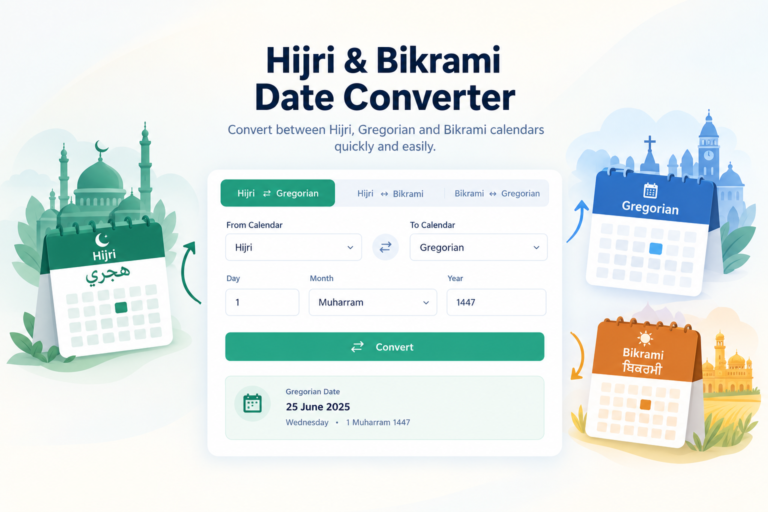
VidHub’s converter turns an Islamic date into a Gregorian date and back again. As a hijri to gregorian date converter it handles birth dates, contracts and certificates, and as a hijri date converter it also shows the day of the week. Pick a tab, choose the starting calendar, type the day, month and year, and the result appears instantly.
This hijri gregorian converter works in both directions, so the same tab covers gregorian to hijri when you press Swap direction. People use it to convert hijri date entries on old documents, to find an islamic date of birth, or to check the hijri date today before an event or Friday prayers.
The hijri calendar is lunar, with twelve months of 29 or 30 days, so its year is about 11 days shorter than the Gregorian year. This hijri converter follows the tabular rule, which matches the umm al-qura islamic calendar used in Saudi Arabia in most months. Pakistan relies on local moon sighting, usually a day later, so choose the moon sighting option to match the islamic date today where you live
Bikrami calendar conversion
The bikrami calendar converter tab works with the Vikram Samvat solar calendar used across Punjab, in land records such as jamabandi and fard, and in old family papers. Choose bikrami to gregorian to read a Chet, Vaisakh or Sawan date in English, or go the other way. Use hijri to bikrami to compare an Islamic date with the desi date today that farmers and patwaris still follow, which is close to the nanakshahi calendar. Results can differ by one day from printed jantris.
Why Hijri and Gregorian dates never line up
A Gregorian year follows the sun and has 365 or 366 days. A Hijri year follows the moon and has only 354 or 355 days. That gap of roughly eleven days means Islamic months slowly drift through every season. Ramadan, for example, moves about eleven days earlier in the Gregorian year each time, so it falls in summer in some years and in winter in others. A full trip around the seasons takes about 33 years.
This drift is why you cannot simply add or subtract a fixed number of years to move between the two systems. Every month has to be checked against the moon, which is exactly the work this tool does for you in a fraction of a second.
Looking for Other tools?
Development
Pick a tool below to get started
Finance
Pick a tool below to get started
Health
Pick a tool below to get started
Frequently asked questions
Months begin when the new moon is sighted, so countries can start a month one day apart. Use the moon sighting selector to match your region.
It uses fixed solar month starts, so it can differ by one day from a printed jantri.
Yes. It is free, runs in your browser and needs no sign-up.
Press the button that fills in today's date and the result box shows it in all three calendars. Hijri years are currently in the 1440s (AH) and Bikrami years are in the 2080s (BS).